Selling a collection 7 min read
How to Sell an Entire Comic Book Collection in New Jersey
Selling a whole collection feels overwhelming mostly because it is unfamiliar. Broken into a few practical steps, it becomes a manageable project, and you do not need to become a comic expert to do it well.
By Evan Little Egg Harbor Township, NJ
Collections in southern New Jersey turn up in every kind of place: a spare bedroom in Toms River, a garage in Galloway, a crawl space in a Long Beach Island shore house, or a parent's basement in Vineland. Some were carefully maintained for decades. Others were packed away once and never opened again. Either way, the steps to sell them are much the same.
This guide covers how to organize a collection without overdoing it, how to protect it while you decide, what information is worth gathering, the common mistakes to avoid, and what to expect when you contact a buyer.
Step one: get a rough count
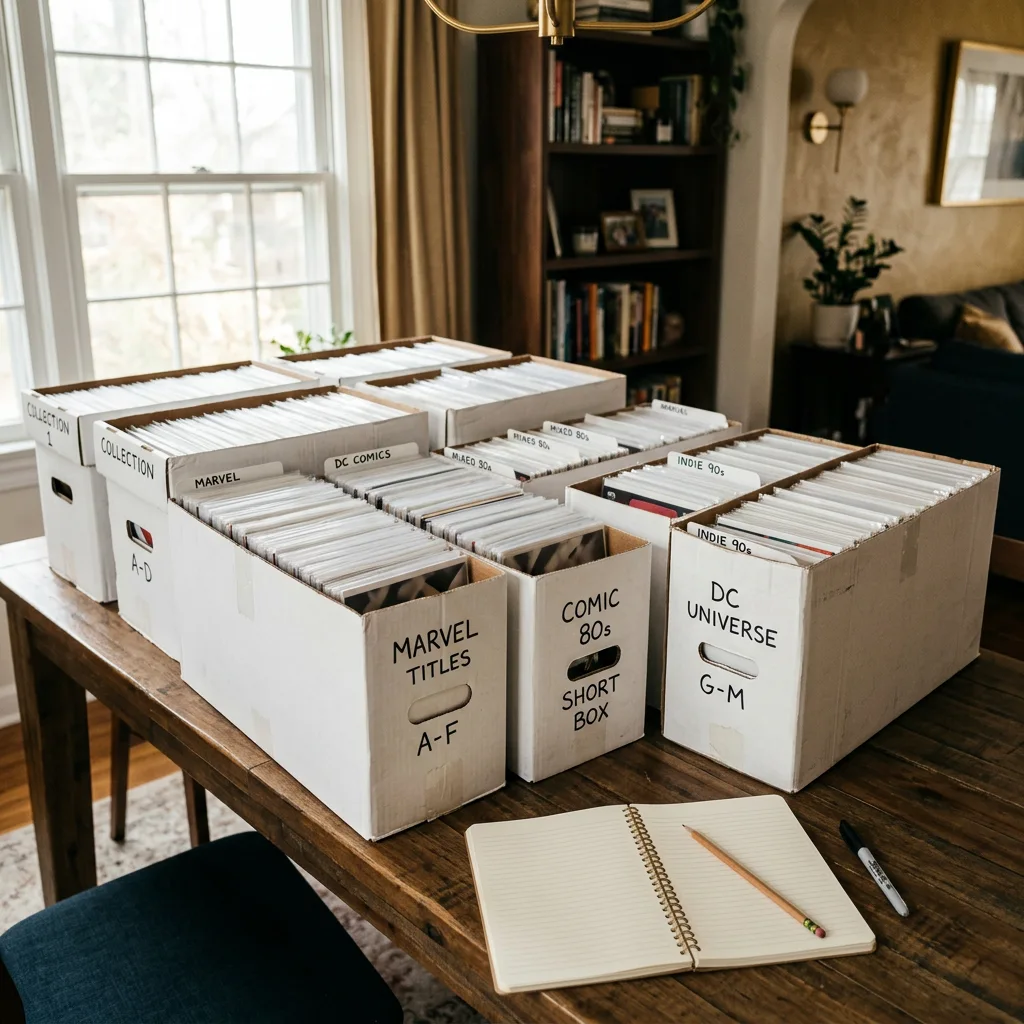
You do not need an exact inventory. A buyer mainly needs a sense of scale. The simplest method is to count boxes. A full long comic box commonly holds around 300 comics, and a short box around 150. Treat those as rough estimates rather than exact capacities, because bag thickness, boards, and how tightly the box is packed all change the number.
Then estimate anything loose: stacks on shelves, books in plastic bins, or comics mixed in with magazines. "Four long boxes, two short boxes, and a bin of maybe a hundred loose books" is a perfectly useful description.
Notice the general shape of the collection
While you count, glance at the covers on top. Note which publishers appear, whether certain titles repeat in long runs, and the general range of cover dates. You might see mostly 1990s superhero books, a mix of decades, or a small group that looks much older. That overview is more helpful than a list of a few individual issues.
Step two: protect the books while you decide
The goal is simply to avoid new damage. The Library of Congress guidance on caring for comic books (opens in new tab) supports the habits collectors already use: handling comics with clean hands, keeping them in bags with supporting boards, and storing them in a stable environment away from light, heat, and humidity extremes.
- If boxes are in an attic, a damp basement, or a shore garage, move them to a cool, dry interior room if you can do so safely.
- Keep boxes upright and off bare concrete floors.
- Do not stack heavy objects on top of comic boxes.
- Leave books already in bags in their bags.
Loose papers are a separate case
Many collections come with paperwork: handwritten lists, old receipts, or notes from the original owner. These can be useful context. Flat paper records are different from bound comic books, and the Library of Congress guidance on caring for works on paper (opens in new tab) advises against using tape, rubber bands, paper clips, or glue on them. Keep those records together in a folder or envelope instead. The same principle applies to the comics themselves: no tape, no rubber bands around stacks, and no clips.
Step three: record what is professionally graded
Some collections include books in sealed plastic holders from a grading company. If yours does, make a simple note of each one. CGC explains on its page about CGC label descriptions (opens in new tab) that the label carries information such as the certification number, the grade, and notations about the book. Writing down the title, issue, grade, and certification number for each holder is plenty.
Do not open the holders. The encapsulation is part of what the certification represents. Vigilante Comics is not affiliated with CGC or any grading company; this is just practical advice for recording what you have.
Step four: take a few photos for your own reference
Photos are useful for your own records and for describing the collection. A picture of each box with the lid off, plus a few of the covers that seem older or more notable, helps you remember what is where. Note that the Vigilante Comics contact form does not accept uploads. If photos would help after the first conversation, Evan will talk with you about whether and how to share them.
Common mistakes to avoid
- Sorting every book before reaching out. A rough count is enough to start, and over-handling causes wear.
- Removing books from bags to inspect them repeatedly.
- Trying to clean, flatten, or repair damaged covers.
- Pricing the collection by adding up the highest online asking prices you can find.
- Splitting off a few books before anyone has looked, which can make the rest harder to describe and sell.
- Posting your full home address or detailed collection photos publicly to attract buyers.
That last point deserves emphasis. When you contact a buyer, share your name, phone or email, and your town or general location. You do not need to publish your street address anywhere public, and a legitimate buyer will arrange specifics directly with you.
Step five: contact a comic book buyer
Once you have a rough count and a general description, you are ready. Vigilante Comics is a buyer, not a store, based in Little Egg Harbor Township and serving communities across southern New Jersey. You can use the contact form, call or text, or send an email.
A strong first message includes:
- Your name and the best way to reach you.
- Your town, so Evan knows where the collection is.
- Approximate box counts and any loose books.
- Publishers, recurring titles, and the general span of cover dates.
- How the books have been stored and any visible damage.
- Whether any books are professionally graded.
What happens next
Evan reviews the details you send, then gets in touch to talk the collection through. That conversation covers what you have, any questions you have, and whether it makes sense to move forward. If it does, you agree together on next steps. Sending an inquiry does not oblige you to accept an offer; ask questions before deciding.
Timing and logistics depend on the collection and your situation, so they are discussed directly rather than promised in advance. If you are handling comics from a family member, the inherited comic collections page covers that situation in more detail, and the comic book collections page explains whole-collection buying.
Keep a simple box-location note while you prepare. If some books are upstairs and others are in a storage unit, record that distinction so you can describe the complete collection accurately. Mention heavy boxes or difficult access during the conversation rather than moving everything to a driveway in advance. There is no reason to risk injury or expose paper to weather just to make an initial inquiry.
A note for estates and downsizing
Many collections come up during an estate, a downsizing move, or a home sale with a deadline. If that is your situation, mention it. You do not need to have anything figured out. Knowing the timeline and the circumstances simply helps the first conversation focus on what matters to you.
Ready for a real conversation?
Tell Evan what you have
Vigilante Comics buys comic books and collections across southern New Jersey. Buyer only, no storefront. Share a rough description and Evan will follow up personally.
Questions owners ask
Frequently Asked Questions
Do I need to sort my collection before contacting a buyer?
No. A rough box count and a general description of publishers, titles, and eras is enough to start. Extra sorting adds handling and wear.
How many comics are in a long box?
A full long box commonly holds around 300 comics and a short box around 150. These are rough estimates; packing and bag thickness change the actual number.
Can I upload photos through the contact form?
No. The form does not accept uploads. If photos would help after the first conversation, Evan will discuss how to share them.
Which New Jersey areas does Vigilante Comics serve?
Vigilante Comics is based in Little Egg Harbor Township and serves 20 southern New Jersey communities, including Long Beach Island towns, Toms River, Galloway, Atlantic City, Hammonton, and Vineland.